
Free written scope consultation - allowances, timeline, and change-order rules on paper before a single trade is scheduled
 Before
 After
After Before
 After
After Before
 After
AfterPlant Prefab Roofing: The Los Angeles Owner’s Guide
We stock and install Plant Prefab-compatible roofing materials across Los Angeles, with most replacement jobs running between $470 and $2,125 installed for repairs and $9,440 to $23,600 for a full roof replacement. The work is typically completed within one to three days once we’ve matched your panel profile. Most owners find out something’s wrong the same way: a water stain shows up on the ceiling after the first real rain of the season, or a panel lifts in a Santa Ana wind and starts flapping against the framing.
Plant Prefab builds homes in their factory, but the roofing system still has to survive real Los Angeles weather once it’s bolted together on your lot. We’ve worked on enough of these homes to know where the weak points are, and we carry the sealants, fasteners, and flashing profiles that match the original factory spec. Barrett & Sons is an independent service provider, not affiliated with Plant Prefab, which means we answer to you, not to a factory warranty department.
Key Takeaways:
- We match Plant Prefab roof panel profiles and flashing dimensions, not just whatever’s on the shelf.
- Installed repair pricing in Los Angeles runs $470-$2,125; full replacement runs $9,440-$23,600.
- Written change orders before any work proceeds, so the price doesn’t move on you.
- Permits pulled and inspections signed on every eligible roof job.
- 90-Day Done Right Promise on every repair and replacement we do.
Which Plant Prefab Models This Applies To
Plant Prefab homes are built in modules and assembled on site, and that changes how the roof is put together. Unlike a traditional stick-built roof, the roofing panels on a Plant Prefab home often arrive pre-installed on the modules, then get joined at the factory seams with a specific flashing and sealant system. We’ve worked on their LivingHome series homes most often, and the roofing systems on those tend to use standing-seam metal or a low-slope membrane depending on which factory line produced the module.
The compatibility gotcha here is the panel-to-seam connection. Plant Prefab modules are joined on site, and that joint is where we see most failures. If you’re trying to identify your exact part, look for a label inside the roof access hatch or on the underside of the panel edge. We usually find the module number and build date stamped there, and that tells us which sealant and flashing profile your roof was built with. If you’re holding an OEM part number, we can cross-reference it. If you’d rather keep costs down, quality aftermarket equivalents from GAF, CertainTeed, and similar brands often match the original spec at a better price. The decision on OEM versus aftermarket comes down to whether your home is still under a Plant Prefab structural warranty and how much of a purist you want to be about the factory spec. We walk you through both options in writing before a single nail moves.
Signs Your Plant Prefab Roofing Is Failing
- Water staining on ceilings or walls near the module seams. Factory seams are the first point of failure on Plant Prefab roofs. The sealant breaks down after enough Los Angeles heat cycles, and water finds the gap.
- A flapping or rattling sound when the Santa Ana winds kick up. Pre-installed panels ride from the factory to the site on a truck. If a fastener wasn’t retorqued after final set on the lot, the panel can work loose over time and start chattering against the framing.
- A visible gap or lifted edge at the panel overlap. Sun exposure on a south-facing Los Angeles roof heats the panel and expands it. Over a decade or so, that expansion-contraction cycle can pull the edge up enough to catch wind and lift the roof.
- Soft spots or spongy areas when you walk the roof. Once water penetrates the top membrane or panel seam, it saturates the insulation or sheathing below it. By the time you feel softness, the damage underneath is always bigger than the stain above suggests.
- White residue or chalky film around flashing joints. That’s sealant breaking down. It’s the same degradation you see on old car weatherstripping, but on a roof it means you’re one good rain away from a leak.
Replacement Cost & What’s Included
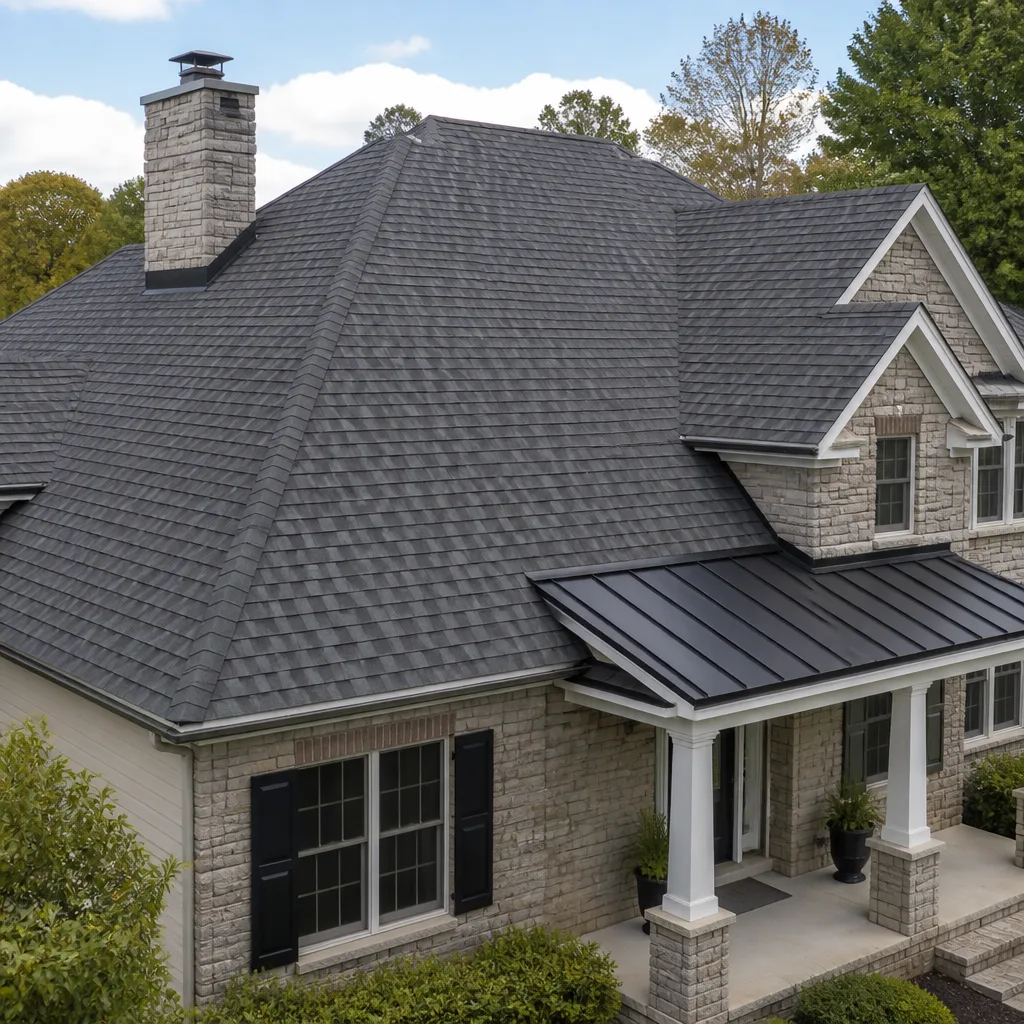
For Los Angeles Plant Prefab homeowners, a targeted roofing repair usually lands between $470 and $2,125 depending on how many seams need resealing, how many fasteners need replacing, and whether we’re pulling up a section of panel to inspect what’s underneath. A full roof replacement on a Plant Prefab home runs $9,440 to $23,600, matching the same range we quote for any quality roof replacement in the area. What drives the spread is access: a two-story module roof with a steep pitch costs more in labor than a single-story with gentle slope, and sometimes we have to rent lifting equipment to safely remove a damaged panel.
Every bid we hand you includes parts and labor broken out as separate line items, so you see exactly what the materials cost and exactly what the crew costs. No allowances that “might change.” No verbal estimate that becomes someone else’s problem at the end. If the scope changes, you get a written change order before we touch anything else. All of it is backed by our 90-Day Done Right Promise, written on the contract in plain English.
DIY or Call Us?
You can safely check a few things yourself: look for visible lifted edges from the ground, check your ceiling for new water stains after a rain, and peek in the attic or roof cavity for daylight coming through the seam. What you should not do is climb up and start pulling fasteners or resealing seams yourself. A Plant Prefab roof is a structural system, and a failed sealant joint can hide water damage that’s compromised the sheathing underneath. One wrong step, and you’re through the panel and onto whatever’s below.
Roof work anywhere carries fall risk. Roof work on a modular home with hidden water damage carries a lot more. We’ve been doing this in Los Angeles since 1998, and we still treat every roof the same way: someone checks the structure before we walk on it, someone’s on the ground the whole time, and nobody rushes. If you’ve got a roof leak or a panel that’s lifting, call us first at (877) 610-1318. We’ll come out, tell you what’s actually wrong, and hand you a written number. No trip charge inside Los Angeles County.
FAQs
Most Plant Prefab roofing systems are designed to last 25 to 40 years, but the Los Angeles climate is hard on roofs. Intense UV exposure, the heat-cold swings between summer and winter, and wind-driven rain all shorten that lifespan. In our experience across Los Angeles, the sealant joints and flashing are the pieces that fail first, often years before the panel material itself gives out.
Most Plant Prefab roof failures we see are repairable: resealing a seam, replacing flashing, retorquing or replacing fasteners. Replacement only makes sense when the underlying sheathing or insulation is saturated, or when the roof has reached the end of its service life. We’ll tell you which one you’re looking at before we quote anything. Call (877) 610-1318 and we’ll start with a real inspection, not a sales pitch.
Most repairs take one day from setup to cleanup. If we’re replacing a section of panel or doing multiple seams across a larger home, expect two to three days. We’ll give you a start date and a finish date in the written bid, and we hold to both.
We keep common sealants, fasteners, and flashing profiles on the truck that match the Plant Prefab factory specs we see most often in Los Angeles. If your home needs a panel ordered, we handle the procurement and bring it to the site. That’s one reason we know the parts costs down to the dollar before we write your estimate.
Written by Tom Barrett, Owner, Barrett & Sons Construction at Barrett & Sons Construction, serving Los Angeles and nearby areas.